
The Growing of Trees Is Called Dendrology - Nature's Engineering Marvel

The growing of trees is called dendrology, but this scientific term barely captures the extraordinary complexity of arboreal development. A single oak tree might grow from an acorn smaller than your thumb into a 100-foot-tall organism weighing several tons over centuries. But how are trees produced with such remarkable consistency across diverse environments? The answer lies in an ingenious combination of biological programming and environmental adaptation. The growing of trees is called a multiphase process that begins with a single seed.
🌲 The Forest Got You Here. We're Here To Give Something Back. Every Natura Nation order plants 3 trees and funds wildlife conservation. Because the trees you love deserve more than admiration. → Shop the Tree Clothing Collection
The Fundamental Question: What Type of Agent Is a Tree Growing?
When we ask what type of agent a growing tree is, we're describing one of Earth's most sophisticated self-organizing systems. Unlike animals that move to find resources, trees are stationary, solar-powered factories that:
1. Manufacture their own food through photosynthesis
2. Build their structural components from atmospheric CO₂.
3. Self-regulate growth patterns based on environmental cues
4. Form complex underground networks through root symbiosis
Recent research from the University of British Columbia reveals that trees even exhibit something akin to "decision-making"; their growth patterns change based on nutrient availability, light conditions, and competition. This explains why the same species of trees grown in open fields develop broad canopies while forest-grown specimens grow tall and narrow. See detailed article: Facts About Trees.

Phase 1: The Growing of Trees Is Called Germination - Nature's Precision Engineering
The growing of trees is called into action through germination, a process far more complex than simply sprouting. Let's examine what makes this phase remarkable:
Genetic Beginnings: Where Do Trees Come From?
Every tree begins as a seed containing:
-
A complete embryonic plant (radicle, hypocotyl, and cotyledons)
-
Stored nutrients (endosperm) for initial growth
-
Protective seed coat programmed to respond to environmental triggers
So, where do trees come from? From a tiny seed with a powerful genetic blueprint. What do trees need to grow from this stage? Surprisingly specific conditions:
-
Some pine species require fire temperatures of 120°F to melt resin and permit germination
-
Many fruit trees need their seeds to pass through animal digestive systems
-
Certain oak varieties must experience prolonged cold periods before sprouting
The journey from a seed to a sapling can take different paths depending on the species.
Root System Establishment
The first visible sign of growth is the radicle (primary root) emerging downward, demonstrating gravitropism. Within days, what a tree needs to grow becomes clear as root hairs develop, increasing surface area up to 100x. Mycorrhizal fungi also colonize roots, forming symbiotic networks that help the plant absorb nutrients.
What do trees need to survive this vulnerable stage?
The initial phase of a tree's growth requires a fragile balance. What do trees need to survive this vulnerable stage? They need consistent moisture (but not saturation), protection from predators and pathogens, and appropriate soil temperatures (typically 50-85°F). This is when trees are most vulnerable to the elements. You may also want to read about Earth's living time capsules in our special article: Oldest Tree in the World.

For those who set an alarm to watch light move through trees
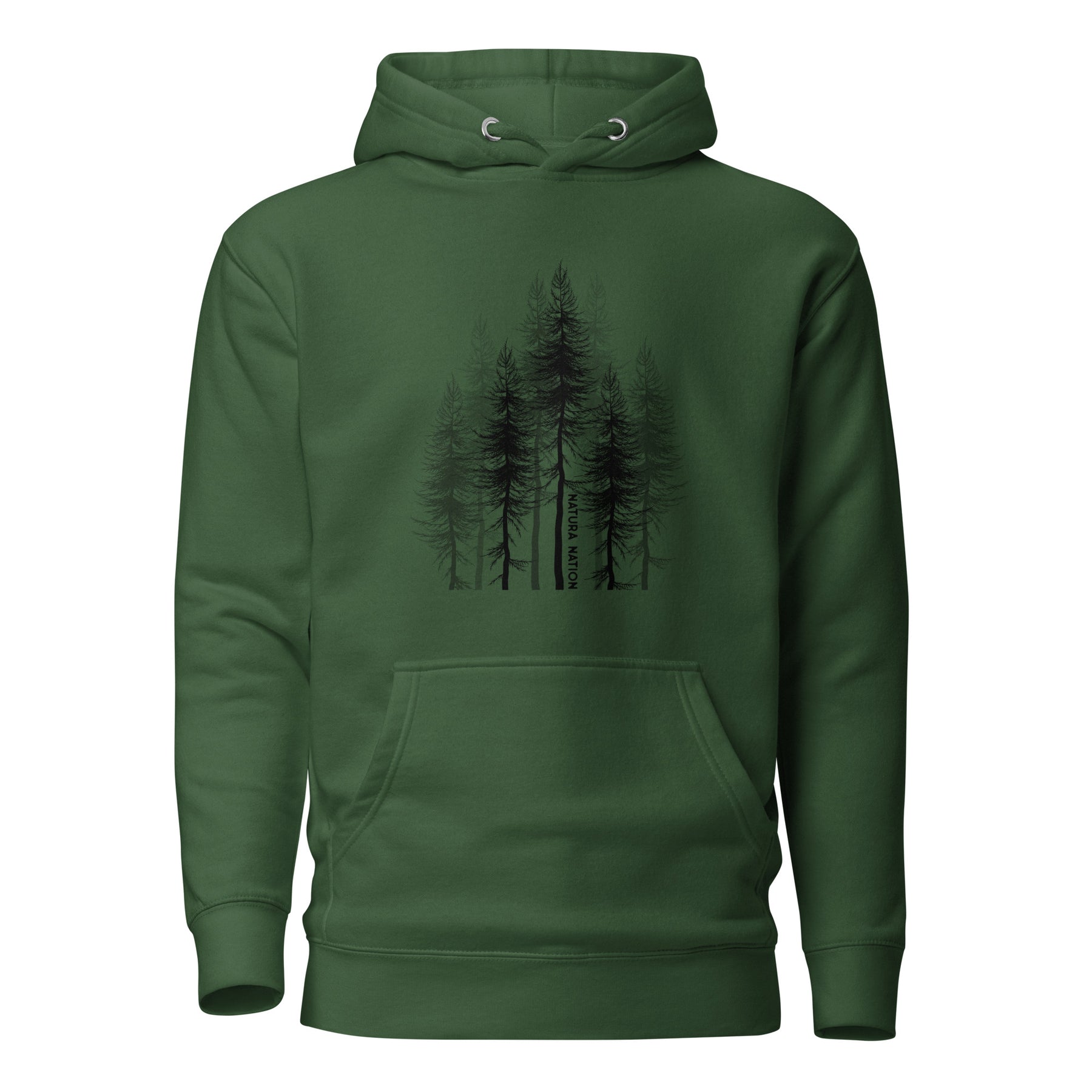
Whispering Forest Pines
There's a specific kind of light that only exists in a forest before 8am, the kind that moves through the canopy in columns and makes everything underneath it look like it was placed there on purpose. Chasing that light is a life choice. This hoodie was made for people who've made it.
Wear the wild. Wear nature. 🌲
Phase 2: Maturation - The Art and Science of Sustained Growth
As saplings transition to mature specimens, what a tree needs to grow becomes increasingly complex. This is the stage where trees truly develop into the giants we know. So, what do trees need to live? The answer is a continuous supply of light, water, nutrients, and carbon dioxide.
The Photosynthetic Engine
Leaves transform into sophisticated solar panels where:
-
Chloroplasts containing chlorophyll capture light energy
-
Stomata regulate gas exchange and water loss
-
Xylem and phloem transport water and nutrients
How does a tree grow upward against gravity? Through a combination of cell elongation in shoot apical meristems, lignin deposition for structural support, and hydraulic pressure from root water uptake.
Annual Growth Patterns
Each year, the tree-growing process leaves visible markers:
-
Spring: Large, thin-walled cells form "early wood."
-
Summer: Smaller, thick-walled cells create "late wood."
This alternation produces recognizable growth rings, and the growing of trees is called a continuous cycle of renewal.
Why Understanding Tree Production Matters for Our Future
Comprehending how trees are produced has never been more critical because:
1. Climate Regulation
Mature trees sequester 48 lbs of CO₂ annually
Urban forests reduce city temperatures by up to 10°F
2. Biodiversity Conservation
A single oak can support 2,300 species
Forest fragmentation disrupts tree grown patterns
3. Sustainable Forestry
Knowing what do trees need to live informs better management
Improved nursery techniques yield healthier saplings
Protecting the Trees with Natura Nation
The fact that you've read this far tells us everything we need to know about you. You're not someone who scrolls past a tree article. You stop. You read. You care about what's happening to the forests and the species that depend on them. Natura Nation was built for exactly you. Every piece in our nature clothing line plants 3 trees in verified reforestation projects and sends 2% of the sale to wildlife conservation — not as a bonus, as the whole point. From nature hoodies to tree tees, our apparel is made for people who wear what they believe and believe that what they wear should mean something.
See the impact your purchase makes and when you're ready, explore our collections. You already know who you are. This is just the clothing that matches.
NATURE'S GREATEST SHOW. YOUR NEW FAVORITE HOODIE.
Whispering Forest Pines Hoodie - Forest Green
This special edition forest green hoodie features our iconic pine tree design, crafted for deep forest exploration. Inspired by the dense, vibrant canopy of ancient forests, its deep, earthy tone captures the spirit of untamed wilderness and connection to nature's profound tranquility.
Crafted for comfort, designed for those who feel most at home among the trees.
✔ Premium mid-weight comfort
✔ Nature-inspired design built for the wild
✔ 3 trees planted with every order
Conclusion: The Growing of Trees Is Called Dendrology - Hope for Our Planet
The growing of trees is called many things: a science, an art, a miracle. But most importantly, it's called essential. From the precise "what does a tree need to grow" requirements to the awe-inspiring "how does a tree grow" mechanisms, this process represents nature's perfect balance of strength and adaptability.
At Natura Nation, we've woven this reverence into our nature clothing initiatives collections because every tree grown is a testament to life's resilience. Join us in celebrating, protecting, and planting these silent guardians that make our world livable.
For more fascinating facts about trees, refer to our special articles:
Does One Tree Produce Enough Oxygen for One Person
References: The Growing of Trees is Called
Tree Growth Mechanisms - Yale School of the Environment
Seed Germination Requirements - USDA Forest Service
Mycorrhizal Networks - Nature Journal Study
Photosynthesis Deep Dive - MIT Biology
Urban Tree Benefits - Arbor Day Foundation Research
Growth Ring Formation - Harvard Arboretum


